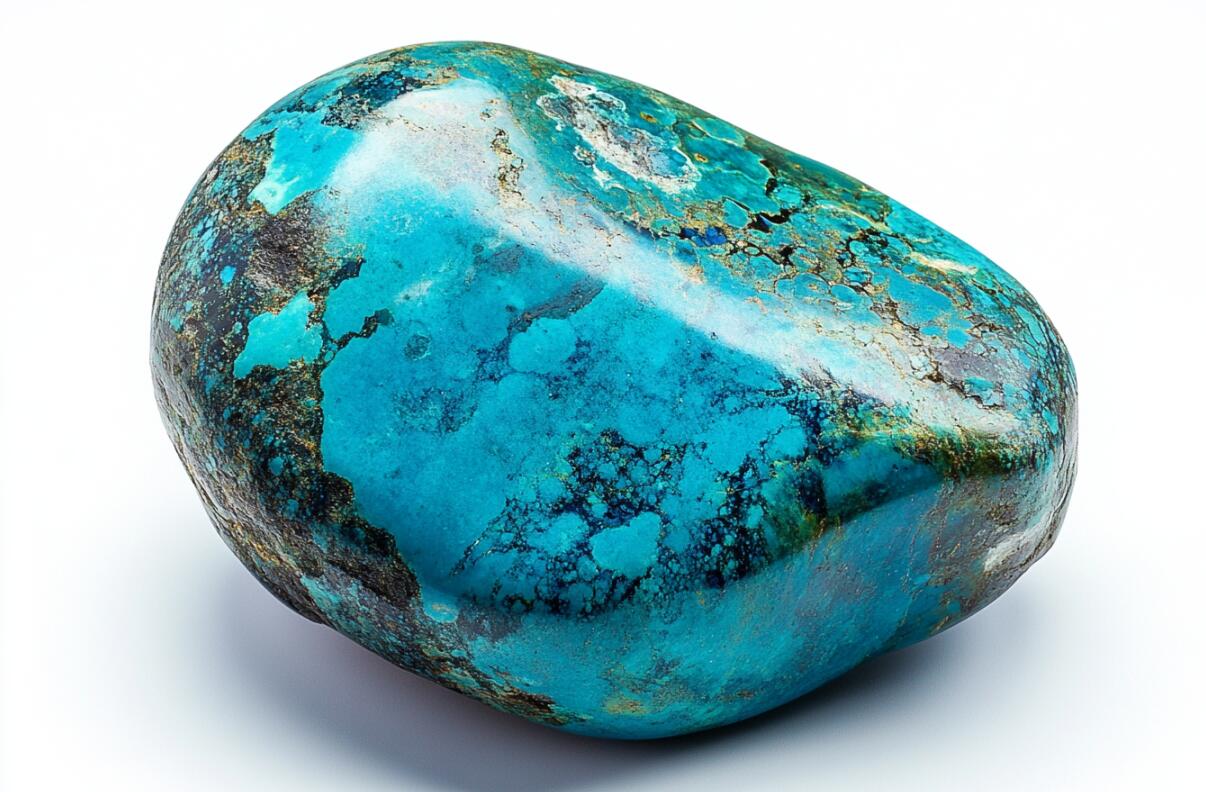
Often confused with turquoise, chrysocolla contains no copper like turquoise does. Instead, it is a hydrated copper phyllosilicate mineral that […]
Name: Chrysocolla
Mineral Category and Species: Phyllosilicate mineral
Structure: Amorphous to microcrystalline
Chemical Composition: (Cu,Al)₂H₂Si₂O₅(OH)₄·nH₂O
Color: Shades of blue, green, turquoise, teal, and cyan
Optical Properties: Translucent to opaque, vitreous to earthy luster, refractive index ~1.46–1.57
Hardness: 2 – 4
Types of Chrysocolla: Pure Chrysocolla, Chrysocolla with Quartz, Eilat Stone, Gem Silica
Main Localities: USA (Arizona, New Mexico), Peru, Democratic Republic of the Congo, Chile, Mexico, Israel (Eilat Stone), Russia
Planet & Zodiac:
Uses:
Healing Properties:
Often confused with turquoise, chrysocolla contains no copper like turquoise does. Instead, it is a hydrated copper phyllosilicate mineral that […]

Chrysocolla is a copper-based mineral that often forms in clusters of small, rounded nodules. Its color ranges from blue-green to […]

Chrysocolla forms in the oxidation zones of copper ore deposits when copper minerals come in contact with silica-bearing groundwater. It […]

The name of Chrysocolla comes from the Greek words chrusos meaning "gold" and kolla meaning "glue", in reference to its […]